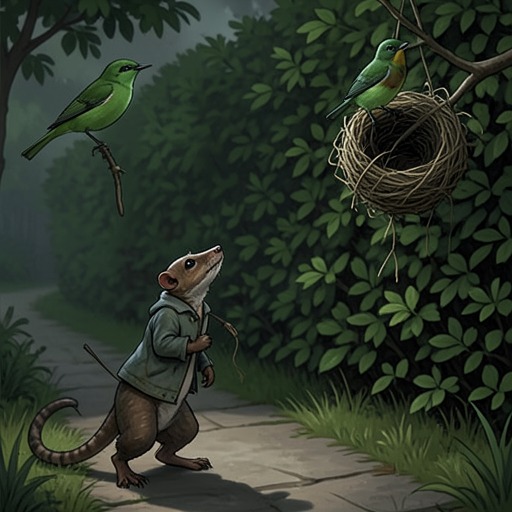
Rikki-tikki-tavi and Darzee
The Jungle BookRikki-tikki-tavi and Darzee are allies forged by a common enemy and sustained by complementary abilities. Rikki-tikki brings the quickness, tooth, and physical courage needed to confront the cobras; Darzee and his wife contribute warnings, knowledge of the garden, and the aerial movement that repeatedly alters the timing of the fight. Their alliance is real but imperfect: Darzee is a gifted singer and anxious father, yet he is often distracted, slow to understand the tactical situation, and dependent on Rikki-tikki’s judgment. Together they help turn the garden from a hunting ground dominated by Nag and Nagaina into a place where no cobra dares show its head.
First Meeting in the Garden
Rikki-tikki encounters Darzee soon after arriving at Teddy’s family home. The garden is large and only partly cultivated, filled with roses, citrus trees, bamboo, and high grass, and the young mongoose initially views it as an excellent hunting ground. His first contact with Darzee is not celebratory but mournful: Darzee and his wife sit on the rim of their carefully stitched nest, crying over the loss of a baby that Nag has eaten. The nest itself is a sign of their domestic skill and vulnerability, made by pulling two leaves together, sewing their edges with fibers, and filling the hollow with cotton and down.
Darzee’s grief gives Rikki-tikki his first clear knowledge of the garden’s danger. When he asks who Nag is, Darzee cannot answer before the cobra’s hiss rises from the grass. Nag emerges as a five-foot black cobra, and the immediate threat exposes the unequal conditions under which the birds live: Darzee’s nest is built out of the snakes’ reach, but safety is only partial while the cobras remain below. Rikki-tikki therefore enters the relationship as an outsider who possesses the capacity to resist a predator that has already become an ordinary terror to Darzee’s family.
Warnings and Mutual Dependence
The first decisive act of cooperation comes when Nagaina approaches Rikki-tikki from behind while Nag occupies his attention. Darzee’s warning, “Behind you! Look behind you!” gives the mongoose the instant he needs. Rikki-tikki does not waste time turning to stare; he leaps, avoiding Nagaina’s strike, and bites her without holding on long enough to break her back. The encounter ends with Nag and Nagaina withdrawing, but Darzee’s warning has converted a concealed attack into a narrowly escaped one.
The episode also establishes the limits of the alliance. Darzee can perceive danger from above, yet Rikki-tikki must interpret the warning and perform the physical response. He is still young and cannot confidently fight both cobras at once, while Darzee’s family remains exposed in the nest. The birds’ knowledge and the mongoose’s speed thus answer different parts of the same problem. Darzee’s warning is not a substitute for action, and Rikki-tikki’s bravery does not make information unnecessary.
After Nag’s Death
After Rikki-tikki kills Nag, Darzee becomes the garden’s first public celebrant of the victory. He sings from the thornbush that Nag is dead and praises the mongoose for catching him by the head until the human man brought the stick that finished the fight. The song records the change in power: the predator who had eaten Darzee’s baby is now a body on the rubbish heap, and the bird’s nest is no longer threatened by that particular cobra.
Yet Rikki-tikki sharply distinguishes celebration from security. He rebukes Darzee for singing while Nagaina remains alive, telling him that the situation is still war for the mongoose below. His impatience is not contempt for Darzee’s courage so much as recognition that song has arrived before the danger is over. Darzee’s instinct is to transform victory into a chant; Rikki-tikki’s is to locate the surviving enemy and prepare for the next movement.
The Plan Against Nagaina
Rikki-tikki recruits Darzee for a specific deception when he learns that Nagaina’s eggs may hatch. He tells Darzee to fly to the stables, pretend that his wing is broken, and draw Nagaina away while he reaches the melon-bed. Darzee initially struggles to see why the eggs must be destroyed, because they are born in eggs like his own babies. His wife understands the larger consequence more clearly: cobra eggs mean future cobras. She therefore carries out the distraction, fluttering before Nagaina by the rubbish heap and claiming that the boy in the house broke her wing with a stone.
This assistance is brave but carefully limited. Darzee’s wife performs the dangerous lure, while Darzee remains with the nest to keep the babies warm and continues singing about Nag’s death. The division reveals both the strength and weakness of the bird household as an ally. Its members can act with intelligence and sacrifice, but Darzee himself is easily carried away by triumph and cannot hold the whole tactical picture in mind. Rikki-tikki’s plan succeeds because the wife supplies practical discipline where Darzee supplies warning and song.
The Final Chase and Lasting Bond
During the final confrontation, Darzee’s wife again affects the course of the action. As Nagaina carries the remaining egg toward the rat-hole, she flaps around the cobra’s head. The distraction lasts only an instant, but that instant lets Rikki-tikki catch Nagaina’s tail before she disappears underground. Rikki-tikki follows her into the dark, hot, moist hole, despite the danger that the passage might widen enough for the cobra to turn and strike.
Darzee interprets the silence as proof of Rikki-tikki’s death and begins a death song. The moment reverses the emotional movement of his earlier chant: public triumph becomes mourning, and the ally who had seemed invincible becomes an absent figure whose fate must be sung. When Rikki-tikki emerges alive, covered in dirt and licking his whiskers, Darzee’s song is interrupted by astonishment. Rikki-tikki announces that the widow will never come out again, confirming that Nagaina has been killed and that the immediate threat to Darzee’s family has ended.
Meaning of the Alliance
The relationship is not based on equality of manner or temperament. Darzee is verbal, musical, domestic, and easily distracted; Rikki-tikki is direct, mobile, and organized around the rapid calculation of attack and escape. Their differences create friction, especially when Darzee sings at the wrong moment or fails to understand the danger posed by the eggs. Nevertheless, those differences also make cooperation possible. Darzee sees from the nest and from the air, while Rikki-tikki controls the ground; Darzee turns events into communal memory, while Rikki-tikki changes the material conditions of life in the garden.
Darzee’s Chant, sung in honor of Rikki-tikki-tavi, gives the alliance a lasting public form. The bird does more than praise a victor: he preserves the story of how courage protected vulnerable lives. Rikki-tikki, for his part, does not become vain after defeating the cobras. He continues to guard the garden with tooth, jump, spring, and bite, until no cobra dares enter. The partnership therefore ends not with a private reward but with an enduring transformation of the shared habitat: Darzee can sing because Rikki-tikki has made the garden safe enough for song.